







Ask most people the difference between AM and FM radio and you will get a shrug, a guess about sound quality, or the confident but incomplete answer that FM is for music and AM is for talk. All of those answers contain a grain of truth, but the full picture is more interesting and more useful than any of them. Understanding the difference between AM and FM helps you make better listening choices and gives you a genuine appreciation for a technology that has been shaping daily life for over a century.
What Is AM Radio?
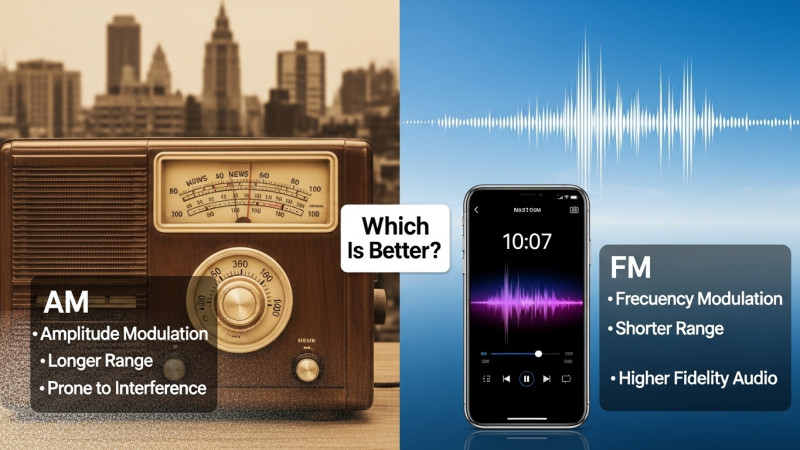
AM stands for Amplitude Modulation. It is the older of the two radio technologies, dating back to the earliest days of broadcast radio in the 1920s. In AM broadcasting, audio information is encoded by varying the amplitude — the strength or height — of the carrier radio wave. The frequency of the wave stays constant, but it gets stronger and weaker in a pattern that represents the audio signal.
AM stations broadcast in the frequency range of 530 kHz to 1700 kHz in North America, and similar ranges elsewhere in the world. KHz stands for kilohertz — thousands of cycles per second. You will notice AM frequencies are stated as three or four digit numbers on your radio dial: 630 AM, 1080 AM, 1580 AM and so on.
What Is FM Radio?
FM stands for Frequency Modulation. Developed by engineer Edwin Armstrong in the 1930s as a deliberate improvement on AM, FM encodes audio by varying the frequency of the carrier wave rather than its amplitude. FM stations operate in the range of 87.5 MHz to 108.0 MHz — megahertz, or millions of cycles per second — which is a much higher frequency range than AM.
The higher frequency range and the modulation method together give FM its characteristic sound quality advantages, while also imposing certain limitations on its range and behavior. Understanding both the advantages and the limitations explains why the two formats have ended up serving such different purposes despite existing side by side for nearly a century.
Sound Quality: FM Wins Clearly
FM audio quality is significantly better than AM, and the reason is directly tied to how interference works. Electrical interference — from lightning, power lines, car engines, fluorescent lights, and countless electronic devices — tends to affect the amplitude of radio waves. Since AM encodes audio in amplitude variations, interference corrupts the audio signal and produces the static and noise that AM listeners know well.
FM encodes audio in frequency variations, which most electrical interference does not affect. The result is dramatically cleaner audio under most conditions. FM also supports stereo broadcasting, introduced in the 1960s, which AM never adopted at scale. The combination of less noise and stereo capability made FM the obvious format for music broadcasting.
Range and Coverage: AM Wins Here
AM radio travels much farther than FM, and this is where the physics of the two formats diverge most dramatically. AM signals at medium wave frequencies can follow the curvature of the Earth — a phenomenon called ground wave propagation — extending their range to several hundred kilometers during the day. At night, AM signals reflect off the ionosphere and can travel thousands of kilometers, allowing powerful AM stations to be heard across entire continents after dark.
FM signals travel in straight lines and do not bend around the Earth's surface or reflect off the ionosphere. A typical FM station covers a radius of 50 to 100 kilometers. Physical obstacles like hills and tall buildings reduce this range further. The trade-off is clear: FM sounds better but reaches fewer people.
| Feature | AM Radio | FM Radio |
|---|---|---|
| Full Name | Amplitude Modulation | Frequency Modulation |
| Frequency Range | 530–1700 kHz | 87.5–108.0 MHz |
| Sound Quality | Mono, more static | Stereo, much cleaner |
| Typical Coverage | Hundreds of km | 50–100 km |
| Night Coverage | Can reach thousands of km | No change |
| Best For | Talk, news, sports | Music, entertainment |
What Content Is on AM vs FM?
The technical characteristics of AM and FM have naturally pushed them toward different types of content. FM's superior audio quality makes it the natural home for music broadcasting — pop, rock, country, classical, jazz, and every other musical genre. The stereo sound and low noise floor make music on FM a genuinely pleasant listening experience.
AM's poorer audio quality matters much less for spoken word content. News, talk radio, sports commentary, religious programming, and political discussion all work perfectly well in mono with some background noise. AM's longer range is actually an advantage for news stations that want to reach rural audiences hundreds of kilometers from the transmitter. Many of America's most prominent news and talk stations — WLW, WSB, WGN — broadcast on AM frequencies that reach millions of listeners across vast geographic areas.
AM Radio at Night: A Special Phenomenon
One of AM radio's most distinctive characteristics is its behavior at night. After sunset, the ionosphere — a layer of electrically charged particles high in the atmosphere — changes its properties and begins to reflect AM radio waves back to Earth rather than absorbing them. Powerful AM stations can suddenly reach audiences thousands of kilometers away that could not hear them during the day.
This nighttime skip phenomenon created much of American radio mythology. Teenagers in the 1950s and 60s staying up late could pick up distant clear-channel AM stations from across the country, discovering music and culture from cities they had never visited. Clear-channel stations like WLS Chicago and KABC Los Angeles became genuinely national presences after dark.
Is AM Radio Dying?
AM radio has been declining for decades, and in some countries the format is genuinely endangered. Australia has switched several AM stations to digital or FM simulcast. Some European countries have shut down AM transmitters entirely. In the United States, AM listenership has fallen significantly as FM and internet audio have captured more audience.
However, AM has proven remarkably resilient. Sports radio, conservative talk radio, religious broadcasting, and emergency information services continue to rely on AM's wide coverage and reliability. In rural America particularly, AM stations serve communities that FM and internet radio have not effectively reached. The format is diminished but far from dead.
Internet Radio: Beyond Both AM and FM
Internet radio eliminates the geographic limitations of both AM and FM. A station broadcasting online can be heard anywhere in the world with equal clarity, regardless of whether it originated on AM or FM frequencies. Many traditional AM and FM stations now simulcast online, extending their reach globally while maintaining their local broadcast licenses.
FreqHub's frequencies directory lists AM and FM frequencies for hundreds of real stations worldwide, so you can see exactly where each station broadcasts on the traditional dial — and then stream it live online from anywhere. Whether you are interested in AM talk stations, FM music stations, or internet-only broadcasts, there are thousands of options waiting to be discovered.
Browse FreqHub's complete directory of AM, FM, and internet radio stations — organized by country, genre, and language — and start listening to the world's radio today.