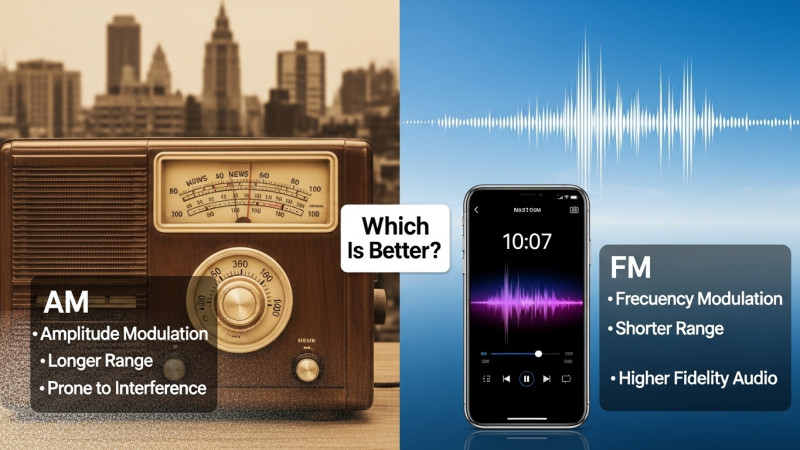








Tune a radio to 100.0 FM in New York and you might hear a classic rock station. Tune to the same frequency in Tokyo and you will hear something entirely different. In London, 100.0 FM carries a major national broadcaster. In São Paulo, it carries another. The same physical frequency carries different content, different cultures, and different communities across the globe — and that shared yet endlessly varied nature of FM radio is one of the things that makes it so endlessly fascinating.
This guide explains how FM frequency allocation works internationally, what frequency ranges are used in different parts of the world, and how you can use FreqHub's frequencies directory to explore FM stations from around the globe.
How FM Frequency Allocation Works
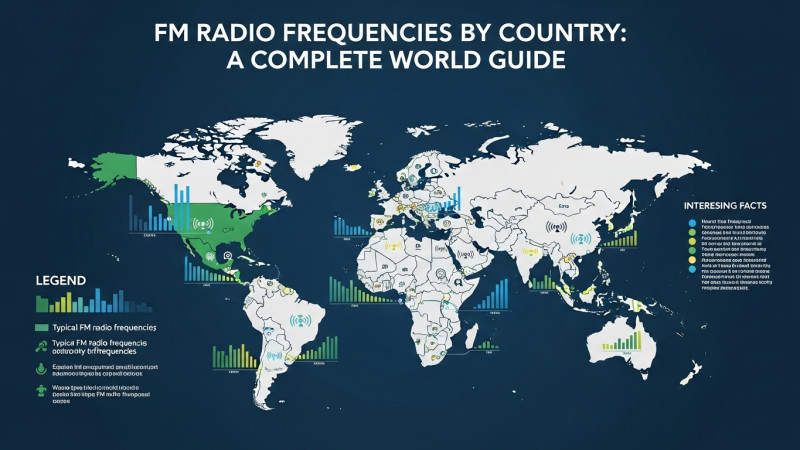
FM radio operates in the frequency range of 87.5 to 108.0 MHz across most of the world, a spectrum band that was internationally standardized to prevent interference between countries' broadcast systems. Within this range, individual stations are assigned specific frequencies — their unique address on the FM dial — that are spaced far enough apart to avoid interfering with their neighbors.
National telecommunications regulators the FCC in the United States, Ofcom in the United Kingdom, the BNetzA in Germany are responsible for assigning frequencies to stations within their territories. The spacing between stations varies by region: 200 kHz (0.2 MHz) in North America, 100 kHz (0.1 MHz) in most of the rest of the world. This is why American FM stations always appear at odd decimal frequencies (88.1, 88.3, 88.5) while European stations can appear at any 0.1 MHz interval (88.0, 88.1, 88.2).
FM Radio Frequencies in North America
The United States, Canada, and Mexico share the standard FM frequency range of 87.5 to 107.9 MHz, with stations assigned at 200 kHz intervals. The FCC divides the FM band into several classes based on transmitter power and antenna height, ranging from small community stations to large commercial broadcasters with regional coverage.
The frequencies from 87.9 to 91.9 MHz are reserved in the United States for non-commercial educational broadcasting public radio, university stations, religious broadcasters, and community stations. This is why NPR affiliates and college radio stations cluster in the lower part of the FM band. Commercial stations occupy 92.1 MHz and above.
Canada operates under essentially the same system as the United States, overseen by the Canadian Radio-television and Telecommunications Commission (CRTC). Mexico's Instituto Federal de Telecomunicaciones assigns FM frequencies on the same 200 kHz spacing, though Mexican FM broadcasting has expanded significantly in recent decades to serve previously underserved rural regions.
FM Radio Frequencies in Europe
European FM broadcasting uses the full 87.5 to 108.0 MHz range with stations assigned at 100 kHz intervals, giving European FM dials noticeably more stations than their North American counterparts. Most Western European countries have densely occupied FM bands, particularly in the United Kingdom, Germany, France, and the Nordic countries where both national and local commercial stations compete for spectrum.
The United Kingdom's Ofcom assigns FM licenses across a sophisticated hierarchy of tiers: national FM networks like BBC Radio 1 and Radio 2 operate on frequencies across the entire country, regional stations cover particular areas, and local commercial stations serve individual cities and towns. BBC Radio 1 broadcasts on various frequencies across the UK, most famously on 97.6-99.8 FM across different transmitters.
Germany's federal structure means FM licensing is managed by sixteen individual state media authorities rather than a single national body, resulting in a particularly rich regional diversity. German FM broadcasting reflects the country's cultural federalism, with each region supporting its own public broadcaster alongside commercial stations. Frequencies like 89.0 FM might carry a Bavaria state broadcaster in Munich and a completely different regional station in Hamburg.
France's Conseil Supérieur de l'Audiovisuel (CSA) manages a similarly complex FM landscape, with national networks, regional stations, and a particularly strong independent and associative radio sector. Radio France — the public broadcasting group that includes France Inter, France Info, France Culture, and France Musique — maintains a nationwide FM presence alongside major commercial networks like RTL, Europe 1, and NRJ.
FM Radio Frequencies in Asia
Asian FM broadcasting presents remarkable diversity because the continent encompasses some of the world's most heavily regulated and some of the most liberalized broadcast markets.
Japan's FM band runs from 76.0 to 95.0 MHz — a notably different range from the rest of the world. Japan adopted this band in the 1960s when the 76-108 MHz range was not yet internationally standardized, and the country has largely retained it. NHK-FM, Japan's public broadcaster, operates at 82.5 FM in Tokyo. Some newer Japanese FM services and digital services now also use frequencies up to 108 MHz. This means that standard FM radios purchased outside Japan may not receive Japanese FM stations, though internet streaming eliminates this barrier entirely.
India operates on the standard 87.5 to 108.0 MHz FM band, and the country's FM sector has expanded dramatically since liberalization in the 2000s. All India Radio (AIR) maintains a nationwide FM presence, while private commercial FM stations — Radio Mirchi, Red FM, Big FM, and dozens of regional operators — have transformed Indian urban radio with professional production and local language programming. Indian cities like Mumbai, Delhi, and Bangalore now have highly competitive FM markets with stations in Hindi, English, and regional languages.
Pakistan's FM band also runs on the standard 87.5 to 108.0 MHz range. Radio Pakistan's FM services operate alongside commercial stations in major cities including Karachi, Lahore, Islamabad, and Multan. Cities like Multan support multiple FM services covering diverse programming needs from music to news to religious content, all accessible online through FreqHub's frequency directory.
China's National Radio and Television Administration manages one of the world's most tightly controlled FM broadcasting environments, with strict content regulations and a market dominated by state and provincial broadcasters. Nevertheless, Chinese FM stations — particularly music stations in major cities like Beijing and Shanghai — attract enormous audiences.
FM Radio Frequencies in Latin America
Latin American countries operate on the standard 87.5 to 108.0 MHz FM band, with most nations using 100 kHz channel spacing. The region has developed some of the world's most vibrant commercial FM markets, particularly in Brazil, Mexico, Argentina, Colombia, and Chile.
Brazil's FM market is highly competitive, particularly in São Paulo and Rio de Janeiro where dozens of stations compete for the attention of enormous urban audiences. Brazilian FM reflects the country's extraordinary musical diversity, with stations dedicated to sertanejo (Brazilian country), forró, funk carioca, axé, MPB, and every international genre. Stations like Radio ALOsertao bring the regional music of Brazil's Northeast to online audiences worldwide.
Mexico City's FM band is among the most competitive in Latin America, with major networks like Grupo Radio Centro, Radiorama, and MVS competing alongside independent stations for the capital's vast audience. Mexican FM spans everything from romantic ballads on Amor 95.3 FM to adult contemporary on ALFA 91.3 FM to regional Mexican music to news and talk programming.
FM Radio Frequencies in Africa
Africa's FM broadcasting landscape is among the most rapidly developing in the world. Most African countries operate on the standard 87.5 to 108.0 MHz band, and the continent has seen extraordinary growth in commercial FM broadcasting since the 1990s when many countries liberalized their broadcast sectors.
South Africa has one of Africa's most developed FM markets, with the SABC operating a network of public radio stations — including Ukhozi FM and Lesedi FM — alongside a competitive commercial sector. South Africa's eleven official languages are reflected in its radio landscape, with dedicated language stations serving Zulu, Xhosa, Sotho, Tswana, and other linguistic communities. Ukhozi FM, broadcasting in Zulu, is the most listened-to radio station on the African continent.
Nigeria, Kenya, Ghana, and Ethiopia have all developed dynamic commercial FM sectors that serve as important platforms for local music, news, and cultural content. FM radio in many African countries performs a connectivity function that has not been replaced by internet media, particularly in regions where smartphone penetration remains incomplete.
FreqHub's Frequencies Directory
FreqHub's frequencies page brings together real FM and AM frequencies for hundreds of stations from across the globe — including the United States, United Kingdom, Germany, France, Japan, India, Pakistan, Australia, Brazil, Mexico, and South Africa. Each station listing shows the broadcast frequency alongside the ability to stream the station live online.
This means you can look up BBC Radio 1's exact London frequency, check what frequency NHK-FM broadcasts on in Tokyo, see Radio Pakistan Multan's transmission frequency for the Punjab region, and stream all of them instantly from the same page. It is the most direct way to connect the physical reality of FM broadcasting with the global accessibility of internet streaming.
Explore FreqHub's complete frequencies directory to discover FM and AM stations from around the world — and stream any of them live with a single click.