




Turn on the radio in your car, and chances are you are tuned to an FM station. Ask someone what FM stands for, however, and most people go quiet. FM frequency modulation is the technology behind the clearest, most widely used radio format in the world, yet very few people actually understand what it is or how it works. This guide explains everything you need to know about FM radio, from the science behind the signal to why it remains relevant in an era of Spotify, podcasts, and internet streaming.
What Does FM Stand For?
FM stands for Frequency Modulation. It is a method of encoding audio information onto a radio wave by varying or modulating the frequency of that wave. The amplitude, or strength, of the wave stays constant, but the frequency shifts slightly to represent the audio signal being transmitted. This is the key technical difference that separates FM from its older sibling, AM (Amplitude Modulation), and it is the reason FM sounds so much better.
The concept was developed and patented by American engineer Edwin Howard Armstrong in 1933. Armstrong spent years fighting the radio industry establishment, which had invested heavily in AM infrastructure, to prove that FM offered dramatically superior audio quality. He was eventually vindicated — FM now dominates music broadcasting worldwide.
How Does FM Radio Work?
A radio station's audio music, voices, sound effects is captured by microphones and converted into an electrical signal. This signal is then used to modulate the frequency of a carrier wave, which is a high-frequency electromagnetic wave that can travel through the air. The modulated carrier wave is amplified and transmitted from an antenna, radiating outward in all directions.
Your FM radio receiver picks up this wave through its antenna, identifies the carrier frequency you have tuned to, and extracts the audio signal by demodulating it — essentially reversing the encoding process. The extracted audio signal is then amplified and sent to your speakers.
The entire process happens in a fraction of a second, which is why live radio sounds genuinely live. There is almost no perceptible delay between a broadcaster speaking and you hearing them.
What Frequency Range Does FM Radio Use?
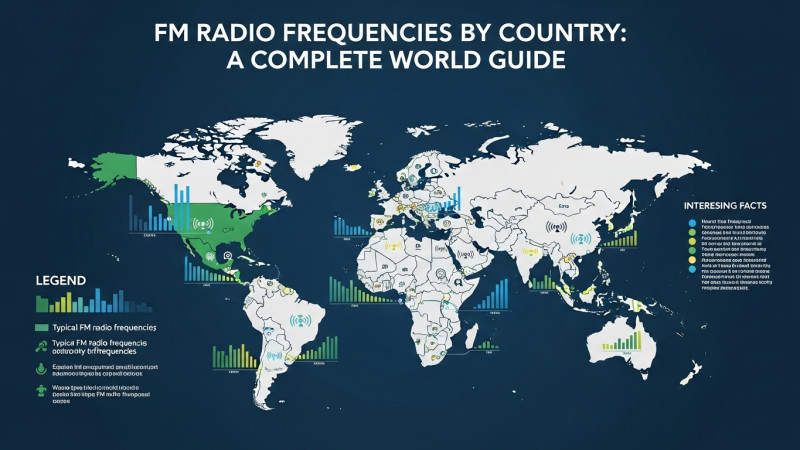
FM radio broadcasts in the frequency range of 87.5 MHz to 108.0 MHz in most of the world. MHz stands for megahertz — millions of cycles per second. Each FM station is assigned a specific frequency within this range, separated from its neighbors by 0.2 MHz (200 kHz) to prevent interference. In North America, stations are assigned on odd decimal frequencies — 88.1, 88.3, 88.5 and so on. In Europe and much of the rest of the world, the spacing is 0.1 MHz.
The frequency you tune to is simply the address of that particular station's carrier wave. When you tune to 97.7 FM, you are instructing your radio to lock onto the carrier wave cycling at 97.7 million times per second and extract the audio from it.
Why Does FM Sound Better Than AM?
FM's audio quality advantage over AM comes down to the nature of radio interference. Electrical interference — from lightning, power lines, electronic devices, and other radio transmissions — tends to affect the amplitude of radio waves rather than their frequency. Since FM encodes audio in frequency changes rather than amplitude changes, most common sources of interference simply do not affect an FM signal the way they devastate AM reception.
FM also supports stereo audio. Stereo broadcasting, which sends separate signals for left and right audio channels, was introduced to FM in the 1960s and is now standard worldwide. AM stations, with some exceptions, broadcast in mono. The combination of interference resistance and stereo capability makes FM the natural choice for music broadcasting, where audio quality genuinely matters.
What Is the Range of an FM Signal?
FM signals travel primarily by line of sight — they do not bend around the curvature of the Earth the way AM signals can. A typical FM broadcast antenna on a high tower can cover a radius of roughly 50 to 100 kilometers under good conditions. Hills, tall buildings, and other physical obstacles can reduce this range significantly.
This limited range is actually a feature in densely populated regions, because it means the same FM frequency can be reused by different stations in cities that are far enough apart. The same frequency that carries a country music station in Nashville might carry a classical station in Atlanta, with no interference between them.
FM Radio Versus Internet Streaming
Internet radio has changed the listening landscape dramatically, but FM has not disappeared. In fact, FM radio remains the most listened-to audio format in many countries, largely because it requires no internet connection, no data, and no subscription. Turn on the radio, tune to a frequency, and the music starts — instantly, reliably, for free.
Internet streaming offers advantages that FM cannot match: unlimited station variety, global access, and the ability to listen to a station from another country as easily as one from your own city. FreqHub brings together the best of both worlds — a directory of thousands of radio stations, including FM stations from around the world, that you can stream online without leaving your browser.
| Feature | FM Radio | Internet Radio |
|---|---|---|
| Sound Quality | Very Good | Excellent (high bitrate) |
| Geographic Range | Local (50-100 km) | Worldwide |
| Requires Internet | No | Yes |
| Number of Stations | Limited (local) | Thousands |
| Cost to Listen | Free | Free (most stations) |
| Works Without Power | Battery radio yes | No |
How to Find FM Radio Stations Near You
The simplest way to find local FM stations is to scan the FM dial on your radio or car stereo — most modern devices have an automatic scan function that detects and saves all receivable stations. In the United States, you can use the FCC's station search tool online to find licensed FM stations in any zip code.
For listening beyond your local area, FreqHub's frequencies directory lists real FM frequencies for stations from the United States, United Kingdom, France, Germany, Japan, Australia, and dozens of other countries. You can click any station and stream it live online, giving you access to FM broadcasts from around the world regardless of where you are.
Is FM Radio Still Relevant?
In an age of algorithmic playlists and on-demand streaming, FM radio's continued relevance might seem surprising. But radio offers something that streaming platforms do not: a human, live, communal experience. A local FM morning show connects you to your city in real time. A live FM broadcast of a national event creates a shared moment for millions of listeners simultaneously. Discovering a song you had never heard because a DJ chose to play it is a fundamentally different experience from an algorithm recommending it based on your listening history.
FM radio survived the arrival of television, cassette tapes, CDs, and MP3 players. It will coexist with internet streaming not because of stubbornness, but because it serves genuine human needs that purely on-demand media cannot fully replace.
Ready to explore FM and internet radio from around the world? Browse thousands of live stations on FreqHub — sorted by genre, country, language, and frequency — and find your next favorite station today.